
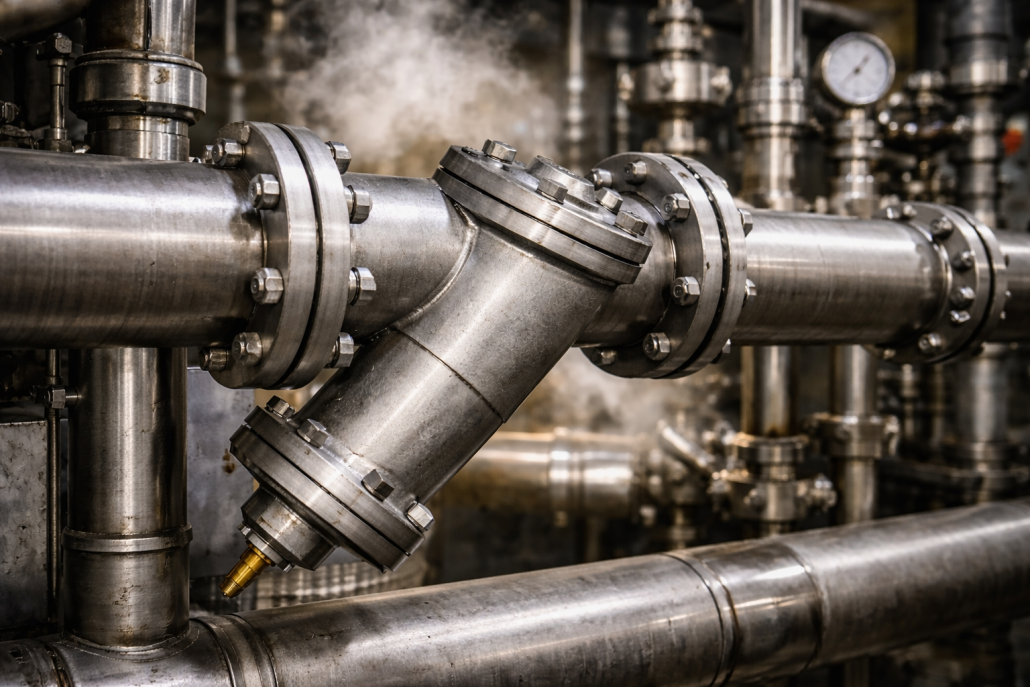
How Do I Select and Size the Correct Strainer for My Pipeline?
At Colton Industries, strainers are one of our core strengths. For decades, our Y-strainers, basket strainers, and temporary strainers have protected steam traps, valves, and equipment in plants across North America.
A well-chosen strainer quietly does its job for years. A poorly chosen one plugs constantly, wastes energy, and frustrates the maintenance team. Here’s how we help customers get it right.
The short answer
To select and size a pipeline strainer, match your line size, operating conditions, fluid, and debris load to the right strainer style, screen/mesh, and pressure drop limit—and make sure it can be cleaned safely and easily.
Start with the basics
Before you select a Colton strainer, gather these details:
- Line size (nominal pipe diameter)
- Operating pressure and temperature
- Fluid type (steam, condensate, water, oil, chemicals, compressed air)
- Cleanliness of the fluid and expected debris load
This information drives material selection, screen type, and overall design.
Choose the right strainer style
Colton offers several strainer options. Each has a natural home:
- Y-Strainers
- Common for: Steam, condensate, gases, general liquids
- Strengths: Compact footprint, can be used in horizontal or vertical (flow-down) lines.
- Best for: General protection where debris is modest and installation space is tight.
- Common for: Steam, condensate, gases, general liquids
- Basket Strainers
- Common for: Larger liquid lines and higher dirt loads
- Strengths: Large screen area, easy basket removal for cleaning.
- Best for: Pump suction, process lines, and applications where you can isolate and open the cover.
- Common for: Larger liquid lines and higher dirt loads
- Duplex Strainers (through our partners and custom solutions)
- Common for: Continuous process lines where stoppages are unacceptable.
- Strengths: Two baskets and a changeover valve allow cleaning one side while the other stays in service.
- Common for: Continuous process lines where stoppages are unacceptable.
- Temporary / Cone Strainers
- Common for: Commissioning and start-up
- Strengths: Low-cost insurance to catch weld slag and construction debris before they reach sensitive equipment.
- Common for: Commissioning and start-up
If you’re not sure which configuration makes sense, your local Steam Specialty rep can walk through options based on your layout.
Select the screen or mesh size
Your screen needs to protect downstream equipment without becoming a constant maintenance issue.
Our rule of thumb:
- Identify the smallest passage downstream (for example, an orifice in a steam trap or a small valve port).
- Specify a screen opening or mesh size slightly smaller than that passage.
- Balance the need for filtration with the reality of how often you can clean or blow down the strainer.
Coarse mesh is easier to live with but lets more fines through. Fine mesh protects better but demands a disciplined cleaning routine. Colton offers multiple screen options so we can fit the right balance to your system.
Consider pressure drop and dirt-holding capacity
Every strainer adds some pressure drop. Too much can reduce system performance.
When we size strainers, we:
- Use manufacturer data to estimate clean pressure drop at your flow rate.
- Consider how quickly screens will load with debris.
- Recommend basket or larger-body strainers when you need more dirt-holding capacity and longer run times.
This is especially important on suction lines and critical process loops where pressure margin is tight.
Confirm materials, ratings, and maintenance details
With Colton strainers, you can choose from:
- Body materials: cast iron, ductile iron, carbon steel, stainless steel, and others based on your service.
- Screen materials: typically stainless steel, especially for steam and corrosive media.
- Pressure ratings: matched to your ASME class and design conditions.
- Connections: threaded, flanged, weld-end options to suit your piping standards.
We also strongly recommend planning for:
- Isolation valves upstream and downstream of the strainer.
- Blowdown valves on Y-strainers for quick, safe flushing.
- Adequate clearance and access for basket removal and cleaning.
Common strainer selection mistakes we see
- Choosing strictly by line size, with no regard for flow or debris load.
- Going too fine on mesh, leading to constant plugging and frustration.
- Forgetting blowdown or isolation, forcing shutdowns for basic cleaning.
- Installing Y-strainers in orientations that don’t allow proper debris collection.
If any of these sound familiar, we can help you correct them on the next upgrade or maintenance window.
A practical checklist for pipeline strainer selection
When working with a Colton or Steam Specialty rep, be ready to answer:
- What are the line size, pressure, temperature, and fluid?
- How dirty is the system and how often can you clean?
- Which style (Y, basket, duplex, temporary) fits your layout and process?
- What mesh size will protect downstream equipment without constant plugging?
- Are the materials, ratings, and access points right for your site?
Once we have those details, we can recommend a strainer that protects your system and keeps maintenance manageable.
