
Y-Strainer vs. Basket Strainer: Which One Should You Use?
What Is the Difference Between a Y-Strainer and a Basket Strainer?
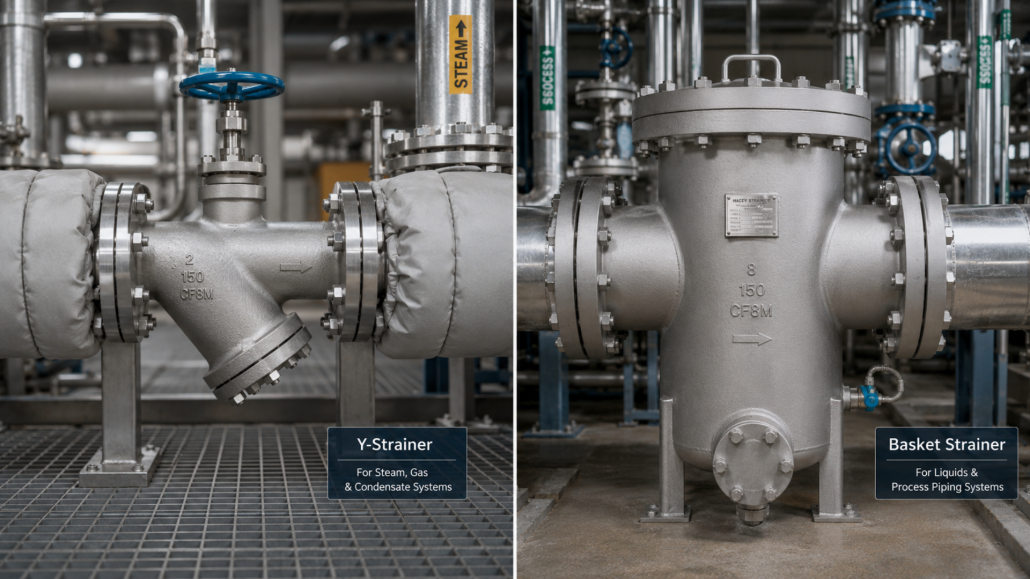
A Y-strainer is a compact pipeline strainer commonly used in steam, gas, condensate, and liquid applications, particularly when debris loading is relatively light. A basket strainer typically provides a larger straining area and greater dirt-holding capacity, making it a strong choice for many liquid systems, higher-flow applications, and services where more debris is expected.
For steam service, Y-strainers are commonly used because of their compact, robust construction. Basket strainers generally provide greater free straining area and lower pressure drop size-for-size, which often makes them better suited to liquid systems and higher debris loads.
Neither type is automatically better.
The right strainer depends on the media, flow rate, pressure, temperature, debris load, required screen opening, acceptable pressure drop, available installation space, and maintenance requirements.
Colton Industries offers a broad range of Y-strainers, basket strainers, duplex strainers, temporary strainers, and replacement screens for industrial and commercial piping systems.
What Does an Industrial Strainer Do?
An industrial strainer removes unwanted solid material from a flowing liquid, gas, steam, or condensate stream before that debris reaches downstream equipment.
Depending on the system, the material being captured may include:
- Rust
- Pipe scale
- Welding debris
- Sediment
- Dirt
- Process solids
- Other foreign material
Strainers are commonly installed to help protect:
- Steam traps
- Control valves
- Pumps
- Flowmeters
- Regulators
- Check valves
- Heat exchangers
- Other sensitive pipeline equipment
In steam systems specifically, strainers are commonly installed upstream of steam traps, flowmeters, and control valves to help protect those components from debris.
The challenge is selecting a strainer that removes the necessary debris without creating unnecessary pressure drop, excessive maintenance, or flow restrictions.
What Is a Y-Strainer?
A Y-strainer gets its name from the shape of its body.
The screen is positioned inside an angled branch extending from the primary flow path. As steam, gas, or liquid passes through the strainer, unwanted solids are captured by the screen.
Y-strainers are used in applications including:
- Steam
- Condensate
- Gas
- Compressed air
- Water
- Industrial process piping
Their relatively compact design can make them useful where installation space is limited.
Colton Industries offers industrial Y-strainers in multiple materials, pressure classes, connection styles, and sizes for different industrial applications.
When Should You Use a Y-Strainer?
A Y-strainer may be the better choice when the system involves the following conditions.
1. Steam or Gas Service
Y-strainers are particularly common in steam piping.
They may be installed upstream of equipment such as:
- Steam traps
- Pressure-reducing valves
- Control valves
- Regulators
- Flowmeters
For steam service, Y-type strainers are widely used because their compact cylindrical body can provide a strong configuration suitable for demanding operating conditions, depending on the specific design and material.
2. Relatively Light Debris Loading
Y-strainers are often well suited to applications where the quantity of material being removed is relatively small.
Because their dirt-holding capacity is generally lower than that of a comparable basket strainer, heavily contaminated systems may require more frequent Y-strainer cleaning.
3. Limited Installation Space
The compact configuration of a Y-strainer can be advantageous in:
- Crowded mechanical rooms
- Tight process piping layouts
- Installations where a larger basket chamber would be difficult to accommodate
4. Applications Requiring Particular Pressure or Temperature Capabilities
Y-strainers are available in a wide range of materials and pressure classes.
For example, Colton Industries offers Y-strainer configurations in cast iron, ductile iron, bronze, carbon steel, and stainless steel, including models designed for higher-pressure service.
Actual pressure and temperature ratings should always be verified for the specific model, material, connection, and application.
What Are the Advantages of a Y-Strainer?
Depending on the application, advantages may include:
- Compact design
- Common suitability for steam and gas
- Smaller installation footprint
- Simple construction
- Multiple pressure-class options
- Multiple material and connection choices
- Blowdown capability on certain designs
Colton’s Y-strainer range, for example, includes threaded, socket-weld, and flanged configurations across several pressure classes.
What Are the Limitations of a Y-Strainer?
The primary consideration is usually dirt-holding capacity and straining area.
Size-for-size, Y-strainers generally have less dirt-holding capacity than basket strainers. As debris accumulates, this may result in:
- More frequent screen cleaning
- Increasing pressure drop
- Reduced flow if maintenance is delayed
This does not mean a Y-strainer is inferior.
It means the design should match the expected debris load and maintenance conditions of the system.
What Is a Basket Strainer?
A basket strainer uses a removable basket-shaped screen inside a larger housing or chamber.
Compared with a Y-strainer, the basket configuration typically provides:
- Greater straining area
- Greater dirt-holding capacity
- Lower pressure drop size-for-size
- More space for captured solids
This makes basket strainers especially useful in many liquid systems and applications where debris loading or flow volume is higher.
Colton offers several basket strainer configurations, including cast iron, carbon steel, stainless steel, duplex, quick-opening, and fabricated designs.
When Should You Use a Basket Strainer?
A basket strainer may be the stronger choice under the following conditions.
1. Higher Flow Liquid Applications
For many higher-flow liquid systems, basket strainers provide an advantage because their larger free straining area can support flow while minimizing unnecessary pressure loss.
Size-for-size, basket strainers generally produce less pressure drop than Y-strainers because of their greater free straining area.
2. Higher Debris Loads
If the fluid carries significant amounts of:
- Sediment
- Rust
- Scale
- Process solids
- Pipeline debris
a basket strainer’s greater dirt-holding capacity can extend the time between cleaning cycles.
3. Maintenance Access Is a Priority
Basket strainers are designed so the basket can be removed from the housing for inspection and cleaning.
Depending on the model, quick-opening cover options may also reduce the effort required to access the basket.
Colton, for example, offers a quick-opening cast iron basket strainer specifically designed with a rotating quick-opening cover.
Adequate clearance still needs to be provided around the installation for safe basket removal and servicing.
4. Continuous Operation Is Important
Some systems cannot be shut down every time a strainer needs cleaning.
A duplex basket strainer can address this challenge by providing two straining chambers. Flow can be directed through one chamber while the other is isolated for cleaning.
Colton includes duplex basket strainers within its basket-strainer portfolio.
This type of design can be particularly valuable in processes where maintaining flow is operationally important.
Y-Strainer vs. Basket Strainer: What Are the Main Differences?
Y-strainers and basket strainers differ in installation footprint, straining area, debris capacity, pressure drop, and recommended applications.
| Selection Factor | Y-Strainer | Basket Strainer |
| Common applications | Steam, gas, condensate and liquids | Primarily liquid systems and selected larger steam applications |
| Design | Compact Y-shaped body | Larger chamber with removable basket |
| Installation footprint | Generally smaller | Generally larger |
| Straining area | Typically lower | Typically greater |
| Dirt-holding capacity | Generally lower | Generally higher |
| Pressure drop | Generally higher size-for-size | Generally lower size-for-size |
| Debris loading | Often suited to lighter loads | Well suited to heavier loads |
| Maintenance | Screen removed from angled branch | Basket typically accessed from top |
| High-flow liquids | Application dependent | Often preferred |
| Steam service | Very common | Application dependent |
| Continuous flow during cleaning | Not typical of a standard Y-strainer | Possible with a duplex basket configuration |
These are general selection guidelines.
Actual performance depends on the specific strainer model, size, screen, material, flow conditions, pressure, temperature, and application.
Which Strainer Is Better for High-Flow Applications?
For many high-flow liquid applications, a basket strainer is generally the better starting point because its larger free straining area can provide lower pressure drop, greater dirt-holding capacity, and longer intervals between cleaning.
However, flow rate should never be considered by itself.
A proper evaluation should also consider:
- Media
- Pipe size
- Fluid velocity
- Viscosity
- Debris concentration
- Screen opening
- Available open area
- Maximum allowable pressure drop
- Operating pressure and temperature
For larger or more specialized applications, Colton also manufactures fabricated basket strainers in a broad range of sizes and configurations, including custom screen open-area ratios, connection options, quick-opening covers, and differential-pressure connections.
Is a Basket Strainer Always Better for High Flow?
No.
High flow does not automatically mean a basket strainer should be selected.
Steam or gas service, pressure requirements, installation constraints, system geometry, and other operating conditions may make a Y-strainer or another configuration more appropriate.
The decision should be based on the complete system.
Does the Strainer Screen Size Matter?
Yes.
Selecting a Y-strainer or basket strainer is only part of the process.
The screen perforation or mesh opening determines the approximate size of debris the strainer is intended to retain.
A finer screen may remove smaller particles, but finer screening can also:
- Increase resistance to flow
- Accumulate debris more quickly
- Increase cleaning frequency
- Increase pressure drop as the screen loads
A screen that is too coarse may allow debris to reach the equipment the strainer is supposed to protect.
That means the goal is not to simply specify the finest screen available.
The goal is to choose an opening that provides appropriate downstream protection while maintaining acceptable system flow.
Colton’s strainer product lines include different standard screen perforations, with additional meshes, perforations, and materials available on selected products.
How Does Debris Load Affect Strainer Selection?
Before choosing a strainer, determine what the screen is actually expected to capture.
Ask:
- What type of debris is present?
- How much debris is expected?
- What particle sizes need to be retained?
- Is contamination continuous or temporary?
- Is heavy debris primarily associated with startup?
- How frequently can maintenance clean the strainer?
A relatively clean steam system may perform well with a Y-strainer.
A liquid system carrying significant solids may benefit from the greater dirt-holding capacity of a basket strainer.
If heavy debris is primarily expected during commissioning, startup, or pipeline flushing, a permanent Y- or basket strainer may not always be the only option.
Colton also offers temporary strainers as part of its pipeline strainer portfolio.
How Does Pressure Drop Affect Strainer Selection?
Every strainer creates some resistance to flow.
The key question is whether that pressure loss remains acceptable for the system.
Pressure drop is influenced by factors including:
- Flow rate
- Fluid properties
- Body design
- Strainer size
- Screen area
- Screen opening
- Debris accumulation
As a screen becomes loaded with debris, resistance increases.
That means a strainer that performs well when clean can eventually become a significant system restriction if maintenance is neglected.
Greater free straining area generally increases flow capacity and helps reduce pressure drop.
In applications where pressure loss is particularly important, differential-pressure connections or monitoring can help maintenance teams identify when screen restriction is increasing.
How Do You Select an Industrial Strainer?
A practical selection process should evaluate at least these seven factors.
1. What Is Flowing Through the Pipe?
Identify the media:
- Steam
- Condensate
- Water
- Gas
- Oil
- Process liquid
- Chemical
- Other media
Media influences strainer type, materials, screen selection, installation, and operating requirements.
2. What Is the Required Flow Rate?
The strainer must accommodate the required system flow without creating unacceptable pressure loss.
Do not assume that matching nominal pipe size automatically means the strainer has adequate flow capacity.
3. What Are the Pressure and Temperature Conditions?
Confirm both normal and design conditions.
The strainer body, screen, gasket, cover, connections, and materials need to be appropriate for the actual application.
Colton’s Y-strainer range illustrates why this matters: different models are available across multiple pressure classes, materials, sizes, and end connections.
4. What Debris Needs to Be Removed?
Identify:
- Particle size
- Type of material
- Expected quantity
- Whether the debris load is continuous or temporary
This helps determine strainer design, screen opening, and required dirt-holding capacity.
5. What Screen Opening Is Required?
The screen should be fine enough to protect downstream equipment without being unnecessarily restrictive.
The downstream equipment’s tolerance should help determine the appropriate mesh or perforation.
6. How Much Pressure Drop Can the System Accept?
Evaluate pressure loss under both:
- Clean-screen conditions
- Expected loaded-screen conditions
For applications with limited available pressure differential, this can become a critical selection factor.
7. How Will the Strainer Be Maintained?
Ask:
- Can the process be shut down for cleaning?
- How often is cleaning likely to be required?
- Is there enough clearance to remove the screen?
- Would quick-opening access be valuable?
- Would blowdown capability help?
- Does the process justify a duplex basket strainer?
- Can maintenance personnel safely access the unit?
Maintainability should be part of the original strainer selection, not an afterthought.
Quick Decision Guide: Y-Strainer or Basket Strainer?
Consider a Y-Strainer When:
- The application involves steam or gas
- Debris loading is relatively light
- Installation space is limited
- A compact design is preferred
- The operating conditions match an available Y-strainer design
- Maintenance intervals are manageable
Explore Colton’s full range of Y-strainers.
Consider a Basket Strainer When:
- The application primarily involves liquids
- Flow requirements are higher
- More debris is expected
- Greater dirt-holding capacity is important
- Lower pressure drop is a priority
- Easier basket access is valuable
- Continuous operation requires a duplex arrangement
Review Colton’s basket strainer options.
Is a Y-Strainer Better Than a Basket Strainer?
Neither design is universally better.
A Y-strainer may be the right solution for a steam line but an inefficient choice for a high-debris liquid process.
A basket strainer may perform very well in a high-flow water system but be unnecessary for a compact steam application with limited debris.
The better question is:
Which strainer matches the media, flow, pressure, temperature, debris load, screen requirements, pressure-drop limits, installation space, and maintenance needs of this system?
That is the decision that matters.
Frequently Asked Questions About Y-Strainers and Basket Strainers
What is the difference between a Y-strainer and a basket strainer?
A Y-strainer has a compact angled screen chamber and is commonly used in steam, gas, condensate, and lighter-debris applications. A basket strainer uses a larger removable basket and generally provides greater straining area, dirt-holding capacity, and lower pressure drop size-for-size.
When should you use a Y-strainer?
A Y-strainer is commonly used for steam and gas service, lighter debris loads, compact installations, and applications where its available pressure, temperature, material, and connection options fit the system.
When should you use a basket strainer?
A basket strainer is commonly used in liquid systems, higher-flow applications, services with heavier debris loads, and installations where greater dirt-holding capacity or easier screen access is important.
Which strainer is better for high-flow applications?
For many high-flow liquid applications, basket strainers are preferred because they generally provide a larger free straining area and lower pressure drop. The final selection should still consider media, pressure, temperature, debris load, and the specific strainer design.
How do you select an industrial strainer?
Select an industrial strainer by evaluating media, flow rate, pressure, temperature, debris characteristics, required screen opening, acceptable pressure drop, installation constraints, and maintenance requirements. Do not select a strainer based on nominal pipe size alone.
Selecting the Right Strainer for the System
Strainers do not operate in isolation.
In real-world steam, condensate, and industrial piping systems, they often protect equipment such as:
- Steam traps
- Valves
- Check valves
- Pumps
- Regulators
- Flowmeters
- Heat-transfer equipment
At Colton Industries, the goal is to help engineers, contractors, facility teams, and maintenance professionals select components that match the actual system requirements, not simply the pipe size.
Colton’s industrial strainer portfolio includes Y-strainers, basket strainers, duplex basket strainers, fabricated basket strainers, temporary strainers, and replacement screens for industrial and commercial piping applications.
Colton Industries has roots in strainer manufacturing dating back to the company’s beginnings in 1988, when its original product line included Y- and basket-type strainers.
Final Takeaway
So, Y-strainer or basket strainer: which one should you use?
A Y-strainer is often the stronger option for steam and gas applications, lighter debris loads, and installations where a compact configuration is important.
A basket strainer is often better suited to liquid systems, higher flow requirements, heavier debris loads, and applications where greater dirt-holding capacity and easier maintenance access are priorities.
Before selecting either type, evaluate:
- Media
- Flow rate
- Pressure
- Temperature
- Debris load
- Screen opening
- Pressure drop
- Installation space
- Maintenance access
- Shutdown requirements
Need help determining which strainer fits your application? Explore Colton’s strainer solutions or contact Colton Industries to discuss your system requirements.
