
How Often Should Steam Traps Be Tested? A Practical Maintenance Guide
How Often Should Steam Traps Be Tested?
Steam traps should generally be tested at least once a year, but many industrial systems require more frequent inspection. Testing frequency should be based on steam pressure, application criticality, operating hours, trap history, failure consequences, and system conditions.
U.S. Department of Energy guidance recommends testing high-pressure traps more frequently than medium- or low-pressure traps, with suggested intervals ranging from weekly or monthly for higher-pressure service to annual testing for lower-pressure applications.
The important point is that steam trap testing should follow a planned maintenance program, not a one-size-fits-all calendar.
At Colton Industries, proper steam trap maintenance starts with selecting the right steam trap for the application and then regularly verifying that it continues to operate as intended. Colton offers float and thermostatic, balanced pressure thermostatic, thermodynamic, inverted bucket, and bi-metal steam trap designs for industrial and commercial applications.
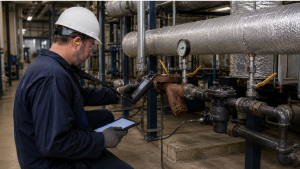
An industrial technician uses ultrasonic diagnostic equipment to evaluate steam trap performance during a routine maintenance inspection.
Why Do Steam Traps Need Regular Testing?
Steam traps perform three critical functions:
- Remove condensate
- Discharge air and other non-condensable gases
- Prevent useful live steam from escaping
A trap can fail open, allowing steam to escape, or become blocked or failed closed, preventing condensate from draining properly.
Either condition can affect the broader system.
Potential consequences include:
- Steam and energy loss
- Poor heat transfer
- Condensate backup
- Water hammer
- Process temperature instability
- Higher operating costs
- Increased maintenance requirements
- Reduced equipment reliability
The challenge is that a failing steam trap may not immediately stop production.
A trap leaking steam can continue allowing equipment to heat while wasting energy. A partially blocked trap may continue operating while gradually reducing performance.
That is why steam traps should not be treated as “install it and forget it” components.
Regular testing helps maintenance teams identify changes before they become larger operational problems.
Is Annual Steam Trap Testing Enough?
Annual testing is a good minimum starting point for many facilities, but it is not sufficient for every steam system.
Spirax Sarco recommends that steam trap surveys be performed at least annually, while noting that the appropriate frequency ultimately depends on the process and application.
The U.S. Department of Energy provides more detailed guidance based on system pressure:
| Steam Pressure | Suggested Testing Frequency |
| High pressure: 150 psig and above | Weekly to monthly |
| Medium pressure: 30–150 psig | Monthly to quarterly |
| Low pressure: below 30 psig | Annually |
These intervals should be treated as maintenance guidance rather than universal rules.
A facility may need to test more frequently when traps:
- Serve critical production equipment
- Operate continuously
- Have a history of failure
- Are exposed to severe conditions
- Have significant consequences if they fail
- Are difficult to detect through normal operations
Conversely, a low-pressure trap on a noncritical seasonal application may not require the same inspection frequency as a high-pressure process trap operating around the clock.
What Determines How Often a Steam Trap Should Be Tested?
A useful testing schedule should consider more than pressure alone.
1. Steam Pressure
Higher-pressure systems generally justify more frequent testing because steam leakage can represent greater energy loss and system conditions can be more demanding.
This is why DOE guidance recommends substantially shorter testing intervals for higher-pressure traps.
2. Application Criticality
Ask what happens if the trap fails.
A failed trap serving a critical heat exchanger, process vessel, hospital system, or production line may have a much greater consequence than one serving a less critical drainage point.
Critical applications often justify more frequent inspection.
3. Operating Hours
A trap operating continuously experiences different service conditions from a trap used only seasonally.
Facilities running steam systems 24/7 may need a more aggressive maintenance schedule than facilities with limited seasonal steam demand.
4. Previous Failure History
A trap or location with repeated failures deserves closer attention.
If the same trap station regularly experiences problems, testing more often may identify deterioration sooner.
Repeated failures should also trigger a larger question:
Is this the correct steam trap for the application?
At Colton Industries, steam trap selection is based on factors such as application, differential pressure, condensate load, operating conditions, and required discharge characteristics rather than pipe size alone.
Explore Colton’s full range of industrial steam traps.
5. Failure Consequences
Consider the potential effects of a failed trap.
Could failure cause:
- Significant steam loss?
- Production disruption?
- Poor process temperatures?
- Water hammer?
- Equipment flooding?
- Safety concerns?
- Product-quality problems?
The greater the consequence, the stronger the case for more frequent testing or monitoring.
6. System Cleanliness
Debris can affect steam trap performance.
Rust, pipe scale, installation debris, and other solids can obstruct small passages or interfere with trap mechanisms.
This is one reason strainers are often installed upstream of steam traps and other sensitive steam-system equipment.
Colton Industries offers Y-strainers, basket strainers, duplex strainers, temporary strainers, and replacement screens for industrial piping applications.
7. Seasonal Operating Changes
Facilities with seasonal heating loads should consider inspections around major operating transitions.
Useful testing periods may include:
- Before heating season
- After winter operation
- During summer shutdowns
- During scheduled maintenance outages
- Following major system modifications
This makes steam trap testing part of the facility’s broader maintenance calendar rather than an isolated annual task.
What Is a Steam Trap Survey?
A steam trap survey is a systematic inspection and evaluation of steam traps throughout a facility.
The objective is to determine whether each trap is:
- Operating normally
- Leaking live steam
- Blocked or failed closed
- Improperly applied
- Installed incorrectly
- Requiring repair or replacement
A good survey should do more than identify “good” and “bad” traps.
It should also document information such as:
- Trap location
- Trap type
- Manufacturer or model
- Application
- Operating pressure
- Condition
- Failure mode
- Recommended action
- Repair or replacement history
This creates a useful maintenance database over time.
Spirax Sarco notes that annual steam trap surveys remain a common way to uncover steam and water losses that may otherwise go unnoticed.
Colton has also previously covered what facilities should include in a mid-year steam trap survey, making survey planning a useful part of a larger steam-trap management program.
How Should Steam Traps Be Tested?
Steam traps should not be judged using only one diagnostic method.
Common evaluation methods include:
Visual Inspection
Visual inspection can identify:
- External leakage
- Damaged piping
- Incorrect installation
- Obvious discharge problems
- Missing insulation
- Corrosion
- Signs of water hammer
However, visual inspection alone cannot reliably determine every internal trap condition.
Temperature Testing
Temperature measurements can help identify whether steam or hot condensate is reaching a trap and may provide clues about blockage or operating conditions.
However:
Temperature alone cannot always distinguish live steam from flash steam.
TLV notes that temperature testing is useful, but temperature readings by themselves can be unreliable for identifying steam leakage because flash steam may be as hot as live steam.
Acoustic or Ultrasonic Testing
Steam traps generate characteristic sounds as steam and condensate move through them.
Acoustic or ultrasonic instruments can help trained technicians evaluate whether the observed operating pattern matches the expected behavior for that trap type.
This can be especially useful when distinguishing:
- Normal cycling
- Continuous steam leakage
- Blocked flow
- Abnormal discharge patterns
Combined Testing
For many applications, the strongest assessment combines:
- Visual inspection
- Temperature data
- Acoustic or ultrasonic testing
- Knowledge of the trap type
- Operating pressure
- Application conditions
A test result should always be interpreted within the context of the actual system.
How Often Should High-Pressure Steam Traps Be Tested?
High-pressure steam traps should generally be tested significantly more often than once per year.
DOE guidance recommends testing traps operating at 150 psig or above weekly to monthly.
The exact frequency should still consider:
- Criticality
- Operating hours
- Trap type
- Historical reliability
- Failure consequences
- Maintenance resources
High-pressure traps serving critical processes may justify particularly close monitoring.
How Often Should Medium-Pressure Steam Traps Be Tested?
For steam pressures between approximately 30 and 150 psig, DOE guidance recommends testing monthly to quarterly.
Facilities can refine that interval based on experience.
For example, a trap that has operated reliably for several years under stable conditions may not require the same schedule as a trap location with recurring failures or variable loads.
How Often Should Low-Pressure Steam Traps Be Tested?
For systems operating below approximately 30 psig, annual testing can be an appropriate baseline according to DOE guidance.
However, low pressure does not automatically mean low importance.
A low-pressure trap serving a critical process or comfort-heating system may still justify more frequent inspection.
Pressure should influence the maintenance schedule, but application risk should influence it too.
Should Steam Traps Be Tested Before Heating Season?
For facilities with significant seasonal heating demand, pre-heating-season steam trap testing is a practical maintenance strategy.
Testing before demand increases gives maintenance teams an opportunity to identify:
- Failed-open traps
- Blocked traps
- Poor condensate drainage
- Clogged strainers
- External leaks
- Improperly operating valves
- Recurring problem locations
Correcting these issues before colder weather can help reduce the likelihood of discovering problems after the system is already operating at higher load.
A pre-season inspection can also be combined with checks of related components such as strainers, valves, check valves, condensate-return piping, and drainage points.
What Happens If Steam Traps Are Not Tested Regularly?
Without regular testing, failed traps may remain in service for months or even years.
A failed-open trap can continue losing live steam while appearing to perform its basic heating function.
A failed-closed or blocked trap can contribute to:
- Condensate accumulation
- Reduced heat transfer
- Equipment flooding
- Water hammer
- Process instability
Even annual testing may leave a significant period between failure and detection.
Spirax Sarco notes that while annual surveys remain common, longer intervals allow more time for failed traps to create energy and operational losses.
A U.S. Department of Energy Better Plants case study provides a useful example: an operator discovered a critical failed steam trap only two weeks after an annual external inspection had been completed, illustrating that a trap can fail at any point between scheduled surveys.
This is why critical traps may benefit from more frequent inspection or continuous monitoring.
Should Every Steam Trap Have the Same Testing Schedule?
No.
Using one testing interval for every trap in a facility is simple, but it may not be the most effective maintenance strategy.
A better approach is to categorize traps based on factors such as:
Higher Priority
- High-pressure applications
- Critical process equipment
- Continuous operation
- Repeated failure history
- High steam consumption
- Significant consequences if blocked
- Difficult-to-detect failures
Standard Priority
- Stable applications
- Moderate pressure
- Good reliability history
- Predictable operating conditions
Lower Priority
- Low-pressure service
- Seasonal or limited operating hours
- Noncritical applications
- Easily detected failures
This creates a risk-based steam trap testing program rather than treating every location identically.
Should Steam Traps Be Continuously Monitored?
For some critical applications, yes.
Wireless or continuous steam trap monitoring can evaluate trap performance between manual surveys and alert maintenance teams when abnormal operation is detected.
This may be particularly valuable for:
- Critical process traps
- Hard-to-access locations
- Large steam systems
- High-pressure applications
- Facilities where steam loss is costly
- Applications where blocked traps could disrupt production
Continuous monitoring is not necessary for every trap, but it can complement manual surveys where the operational or financial consequences of failure justify it.
What Should Be Included in a Steam Trap Maintenance Program?
A strong steam trap management program should include more than testing.
Maintain a Trap Inventory
Assign each steam trap a unique identifier and record:
- Location
- Application
- Trap type
- Size
- Pressure conditions
- Installation date
- Service history
Establish Testing Frequency
Set intervals based on:
- Pressure
- Criticality
- Operating hours
- Failure history
- Application
- Consequences of failure
Document Results
Record:
- Test date
- Trap condition
- Diagnostic method
- Observed symptoms
- Recommended corrective action
Repair or Replace Failed Traps Promptly
Finding a failed trap has little value if corrective action is continually delayed.
Investigate Repeat Failures
When the same trap repeatedly fails, evaluate:
- Trap selection
- Sizing
- Differential pressure
- Condensate load
- Debris
- Installation
- Backpressure
- Piping conditions
Review Related Components
Steam trap performance can be influenced by:
- Strainers
- Isolation valves
- Check valves
- Condensate piping
- Return pressure
- Drainage configuration
A steam trap should always be evaluated as part of the system around it.
Frequently Asked Questions About Steam Trap Testing
How often should steam traps be inspected?
At least annually is a common baseline, but inspection frequency should increase for higher-pressure, critical, continuously operating, or historically unreliable traps. DOE guidance recommends intervals ranging from weekly or monthly for high-pressure traps to annual testing for low-pressure traps.
How often should steam traps be tested?
There is no single interval appropriate for every system. High-pressure traps may require weekly or monthly testing, medium-pressure traps monthly to quarterly, and low-pressure traps annually. Application criticality and failure history should also influence the schedule.
Is an annual steam trap survey enough?
Annual surveys are a good minimum program for many facilities, but critical or high-pressure traps may need more frequent testing. Annual surveys can identify failed traps, but a trap can fail at any point between inspections.
What is the best way to test a steam trap?
The strongest approach typically combines visual inspection, temperature measurement, acoustic or ultrasonic testing, and knowledge of the trap’s expected operating pattern. Temperature alone should not be used to diagnose all steam leaks.
When should steam traps be replaced?
A steam trap should be repaired or replaced when testing confirms that it is no longer performing correctly and the cause cannot be resolved through appropriate maintenance. Repeated failures should also trigger a review of whether the trap is correctly selected for the application.
Build Testing Around the System, Not Just the Calendar
There is no universal testing schedule that works for every steam trap.
For many facilities, annual testing provides a reasonable baseline.
But a high-pressure trap serving critical process equipment should not necessarily receive the same maintenance schedule as a low-pressure trap on a seasonal heating line.
The stronger approach is to consider:
- Pressure
- Application
- Criticality
- Operating hours
- Failure history
- Energy impact
- Safety and reliability consequences
Then establish testing intervals accordingly.
At Colton Industries, our goal is to help facility teams, engineers, contractors, and maintenance professionals select steam and pipeline components that fit the real operating requirements of the system.
Colton Industries has provided commercial and industrial flow-control solutions since 1988 and offers steam traps, strainers, valves, check valves, flexible connectors, and related pipeline specialties.
Final Takeaway
How often should steam traps be tested?
Use annual testing as a minimum baseline for many systems, but increase frequency when pressure, application criticality, operating hours, failure history, or consequences justify it.
As a practical starting point:
- High pressure: weekly to monthly
- Medium pressure: monthly to quarterly
- Low pressure: annually
Then adjust the schedule based on actual facility experience and operating risk.
A strong steam trap program should combine proper selection, routine testing, accurate recordkeeping, timely repair or replacement, and investigation of recurring failures.
Explore Colton’s industrial steam trap solutions or contact Colton Industries to discuss steam trap requirements for your application.
