
How Do You Prepare a Steam and Condensate System for Winter?
How Do You Prepare a Steam System for Winter?
Preparing a steam and condensate system for winter means verifying that condensate can drain properly, steam traps are working, strainers are clear, valves and check valves operate correctly, exposed piping is protected, and known water-hammer or freeze-risk areas are addressed before temperatures fall.
For many facilities, the most important winter-readiness priorities are:
- Test steam traps
- Inspect condensate drainage
- Clean strainers
- Check valves and check valves
- Review condensate-return piping
- Inspect insulation and exposed lines
- Correct known water-hammer problems
- Confirm cold-weather operating and emergency procedures
The goal is not simply to “winterize” individual components. It is to make sure the steam supply and condensate return system can continue operating reliably as heating demand, condensate load, and cold-weather exposure increase.
At Colton Industries, that system-level approach matters. Colton supplies steam traps, strainers, check valves, pressure-reducing valves, flexible connectors, and related pipeline specialties for commercial and industrial applications throughout North America.
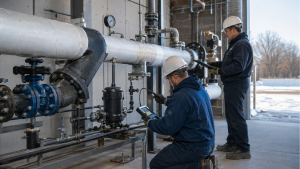
Maintenance technicians inspect steam traps, valves, strainers, and condensate components before cold-weather operation.
Why Do Steam and Condensate Systems Need Winter Preparation?
Cold weather can expose problems that were less noticeable during warmer months.
As heating demand increases, steam systems may experience:
- Longer operating hours
- Higher condensate loads
- More frequent cycling
- Cold piping during startup
- Greater heat loss from exposed piping
- Increased demand on steam traps
- Increased demand on condensate-return systems
- Greater consequences if drainage is inadequate
A trap that was marginal during summer may struggle under a heavier condensate load.
A partially clogged strainer may create more noticeable pressure loss.
A poorly drained low point may become a recurring source of water hammer.
An exposed condensate line that operated without issue during mild weather may become vulnerable when outdoor temperatures drop.
Colton’s existing maintenance guidance emphasizes that steam traps, strainers, valves, and condensate-return lines work together, and seasonal inspections are an opportunity to identify problems before the next period of heavy use.
What Should You Inspect Before Winter?
A practical winter-readiness inspection should cover these eight areas.
1. Test Steam Traps Before Cold Weather Arrives
Steam traps should be near the top of the winter maintenance checklist.
A properly operating steam trap removes condensate and air while limiting the loss of useful live steam.
When a trap fails open, it may waste steam.
When a trap fails closed, becomes blocked, is undersized, or cannot discharge against downstream pressure, condensate may accumulate.
Before winter, look for:
- Traps continuously passing live steam
- Traps that appear blocked
- Poor condensate discharge
- Unusual temperature patterns
- External leakage
- Slow-heating equipment
- Water hammer near trap stations
- Repeat-failure locations
Why are steam traps especially important in winter?
Steam traps become particularly important during cold-weather operation because effective condensate removal helps keep steam lines and equipment draining as heating loads increase.
Poor drainage can contribute to:
- Condensate backup
- Reduced heat transfer
- Water hammer
- Poor heating
- System instability
Colton’s existing steam trap guidance notes that water hammer, flooded equipment, poor heating, and slow startup can all be associated with trap or drainage problems.
Explore Colton’s steam trap solutions for industrial and commercial steam applications.
2. Check Condensate Drainage Throughout the System
Reliable winter operation depends heavily on getting condensate out of steam piping and equipment.
Inspect:
- Steam-main drip legs
- Low points
- Branch lines
- Trap stations
- Equipment drains
- Condensate-return connections
- Areas with a history of flooding
- Outdoor or exposed sections
Why is condensate drainage so important in winter?
Condensate that remains where it should not can contribute to water hammer, poor heat transfer, equipment flooding, and cold-weather reliability problems.
During startup, cold steam piping can produce significant condensate as the pipe warms.
During normal winter operation, greater heating demand can also increase the volume of condensate the system needs to handle.
The system therefore needs enough drainage capacity for both startup conditions and normal operating load.
If condensate repeatedly accumulates in the same location, do not simply assume the nearest steam trap needs replacement.
Check:
- Pipe slope
- Drainage design
- Trap sizing
- Differential pressure
- Return-system pressure
- Strainer condition
- Isolation valves
A mechanically functional steam trap cannot overcome every system-design problem.
3. Inspect and Clean Strainers
Strainers protect steam traps, valves, regulators, meters, and other downstream equipment from debris such as:
- Rust
- Scale
- Sediment
- Weld material
- Dirt
- Other pipeline solids
Before winter, inspect screens or baskets for debris buildup.
A clogged strainer can:
- Increase pressure drop
- Restrict flow
- Affect downstream equipment
- Interfere with condensate drainage
- Increase maintenance problems
Colton’s maintenance guidance recommends checking differential pressure where available, cleaning or blowing down Y-strainers as needed, inspecting baskets and screens, and checking for damaged or collapsed elements.
Colton offers Y-strainers, basket strainers, duplex strainers and related strainer solutions for industrial piping applications.
Should strainers automatically be cleaned before winter?
They should be inspected, but cleaning should be based on actual condition rather than the calendar alone.
Useful indicators include:
- Increased differential pressure
- Reduced flow
- Heavy debris loading
- Poor downstream performance
- Operating history
The objective is to enter winter with adequate flow area and without unnecessary restriction.
4. Inspect Exposed Condensate Lines for Freeze Risk
Not every section of a steam system has the same cold-weather exposure.
Outdoor piping, unheated mechanical areas, loading docks, rooftop systems, and other exposed locations deserve additional attention.
Look for condensate that may remain in:
- Low points
- Dead legs
- Improperly pitched lines
- Isolated equipment
- Shutdown sections
- Outdoor trap stations
- Poorly draining return piping
Can condensate lines freeze?
Yes. Any section containing standing water or condensate can become vulnerable when exposed to sufficiently cold temperatures.
A steam line itself may be hot during operation, but sections of the condensate system can behave differently, particularly during shutdowns or intermittent operation.
Winter preparation should therefore consider what happens after the steam system shuts down, not only while it is operating.
Ask:
- Does this section drain completely?
- Can condensate become trapped?
- Is piping exposed to outdoor temperatures?
- Does the area remain heated during shutdown?
- Are valves creating isolated sections filled with condensate?
Freeze prevention should be based on the actual facility, environment, piping configuration, and applicable engineering requirements.
5. Investigate Water Hammer Before It Gets Worse
Recurring banging, knocking, or pipe movement should be addressed before winter operation increases.
Water hammer in steam systems is frequently associated with condensate collecting where it should not.
Possible contributors include:
- Failed or misapplied steam traps
- Poor pipe slope
- Inadequate drainage
- Clogged strainers
- Rapid startup
- Excessive condensate-return pressure
- Equipment stall
- Undrained dead legs
Can winter conditions make water-hammer problems more noticeable?
Yes. Increased heating demand and cold piping during startup can increase condensate production, which can expose existing drainage problems.
A location that hammered occasionally last winter should be treated as a known maintenance priority, not something to “watch and see” for another season.
Document:
- Where the hammer occurs
- When it happens
- Whether it is limited to startup
- Whether it occurs during steady operation
- Which traps and drainage points are nearby
- What corrective work has already been attempted
The objective is to identify the root cause rather than repeatedly replacing the closest component.
6. Check Valves and Check Valves
Winter readiness also depends on valves operating correctly.
Inspect isolation, control, pressure-reducing, and check valves for:
- External leakage
- Packing leakage
- Corrosion
- Difficulty operating
- Incomplete opening or closing
- Chattering
- Abnormal noise
- Reverse-flow symptoms
Why do check valves matter in condensate systems?
Check valves help prevent unwanted reverse flow.
Where condensate-return pressures vary, a malfunctioning check valve can contribute to unstable system conditions.
Valves should also be checked because partially closed or poorly operating valves can create restrictions that complicate steam-system troubleshooting.
Colton’s current portfolio includes check valves, pressure-reducing valves, quarter-turn valves, triple-duty valves, and other pipeline flow-control equipment.
7. Inspect Insulation and Pipe Protection
Insulation is an important part of cold-weather system performance.
Inspect:
- Steam mains
- Branch lines
- Valves and fittings where appropriate
- Condensate piping
- Outdoor lines
- Equipment connections
Look for:
- Missing insulation
- Wet insulation
- Damaged jacketing
- Loose sections
- Areas removed during maintenance
- Signs of corrosion beneath damaged insulation
Why does damaged insulation matter?
Missing or damaged insulation increases heat loss.
In steam service, that can mean:
- More steam condensing in the piping
- Higher energy demand
- Greater condensate load
- Hotter mechanical spaces
For condensate piping exposed to cold environments, insulation and other freeze-protection measures may also form part of the facility’s winter strategy.
Always follow the facility’s engineering standards and specific equipment requirements when insulating system components.
8. Review Startup, Shutdown, and Emergency Procedures
Winter reliability is not only about hardware.
Operating procedures matter.
Before the heating season is fully underway, maintenance and operations teams should review:
Startup Procedures
Confirm how the system should be warmed gradually and how condensate will be drained during startup.
Shutdown Procedures
Determine what happens to condensate when steam is isolated.
Can any exposed section remain filled with water?
Freeze Response
Know which systems, branches, or outdoor components are most vulnerable if:
- A boiler shuts down
- Electrical power is lost
- Building heat is interrupted
- Steam supply is unavailable
Emergency Isolation
Confirm that critical isolation valves are accessible and functional.
A winter plan should identify vulnerabilities before an outage happens, not during one.
How Do You Prevent Condensate Lines From Freezing?
There is no single freeze-prevention method appropriate for every facility, but the first principle is straightforward:
Avoid leaving standing condensate in piping exposed to freezing conditions whenever the system design allows it to drain.
Maintenance teams should evaluate:
- Pipe slope
- Drain locations
- Steam traps
- Check valves
- Low points
- Outdoor piping
- Insulation
- Shutdown conditions
- Heat tracing or other engineered freeze-protection measures where applicable
The exact solution depends on the application.
For some systems, reliable drainage may be the primary defense.
For others, insulation, heat tracing, enclosure heating, revised piping, or other engineered measures may be required.
Do not assume that insulation alone will correct a piping section that cannot drain properly.
Can a Failed Steam Trap Cause Freeze Problems?
A failed or blocked steam trap can contribute to conditions that leave condensate where it should not remain, which may increase cold-weather risk in exposed portions of a system.
However, freeze problems should not automatically be blamed on the trap.
Also investigate:
- Piping slope
- Low points
- Trap selection
- Return pressure
- Check valves
- Shutdown conditions
- Exposure to outdoor temperatures
Colton’s guidance on selecting the right steam trap for an application emphasizes application, operating pressure, condensate load, differential pressure, materials, connections, and maintenance access.
This is especially important in winter because a trap that is technically functioning may still be wrong for the operating conditions.
Should Steam Trap Capacity Be Reviewed Before Winter?
In some systems, yes.
If operating conditions or heating loads have changed, confirm that the installed trap can handle the expected condensate load.
Ask:
- Has equipment capacity changed?
- Has steam pressure changed?
- Has condensate-return pressure changed?
- Has the process been modified?
- Does the trap struggle during startup?
- Has the same location repeatedly flooded?
For example, Colton’s CFTS float and thermostatic steam traps are designed for continuous condensate discharge in applications such as air-handling coils, heat exchangers, hot-water generators, and steam process equipment, illustrating why application and condensate capacity matter when selecting a trap.
The correct answer is not always “install a larger trap.”
The goal is to verify appropriate capacity at the actual differential pressure and operating conditions.
What Should Be on a Winter Steam System Checklist?
Use this practical checklist before and during cold-weather operation.
Steam Traps
- Test operation
- Identify leaking or blocked traps
- Check repeat-failure locations
- Confirm adequate drainage
- Review application and sizing where problems recur
Strainers
- Check differential pressure where available
- Inspect screens and baskets
- Remove excessive debris
- Replace damaged screens
- Confirm appropriate orientation
Steam Distribution
- Check low-point drainage
- Inspect drip legs
- Review piping slope
- Investigate water-hammer locations
- Inspect pipe supports
Condensate Return
- Look for restricted piping
- Check outdoor and exposed lines
- Inspect check valves
- Review backpressure
- Identify freeze-prone locations
- Confirm lines can drain during shutdown
Valves
- Check smooth operation
- Inspect leakage
- Confirm critical isolation valves are accessible
- Review pressure-reducing equipment
Insulation
- Repair missing insulation
- Inspect damaged jacketing
- Check exposed piping
- Investigate wet insulation
Operations
- Review startup
- Review shutdown
- Identify critical cold-weather equipment
- Confirm freeze-response procedures
- Document known problem areas
Which Steam-System Areas Should Receive the Highest Winter Priority?
Not every component carries the same risk.
Facilities should prioritize locations where failure would have the greatest operational consequence.
High-Priority Areas May Include:
- Outdoor trap stations
- Exposed condensate lines
- Critical heating equipment
- Air-handling units
- Heat exchangers
- Repeated water-hammer locations
- Traps with a history of failure
- High-pressure applications
- Hard-to-access components
- Areas required for freeze protection of the facility itself
This is essentially a risk-based winter maintenance strategy.
Rather than treating every trap and valve identically, prioritize the locations where failure could:
- Stop heating
- Damage equipment
- Interrupt production
- Create water hammer
- Leave piping vulnerable to freezing
- Require emergency repairs
What Should You Do If a Steam System Shuts Down During Freezing Weather?
A winter shutdown deserves immediate attention because steam lines, equipment, and condensate piping begin cooling once steam supply stops.
The facility’s specific emergency procedure should guide the response.
Operational questions should include:
- Which areas can retain condensate?
- Which outdoor lines are vulnerable?
- Can exposed piping drain?
- Which equipment must remain heated?
- Are isolation and drain valves accessible?
- Is backup heat available?
- Which components should maintenance inspect before restart?
Avoid simply restarting the system at full steam after an extended cold shutdown.
Cold piping can generate a significant startup condensate load, so restart should follow the facility’s approved warm-up and drainage procedures.
Frequently Asked Questions About Winter Steam-System Preparation
How do you prepare a steam system for winter?
Test steam traps, inspect drainage points, clean strainers as needed, check valves and check valves, review condensate-return piping, repair insulation, investigate known water hammer, and identify piping vulnerable to freezing.
Should steam traps be tested before winter?
Yes. Testing before cold weather helps identify leaking, blocked, misapplied, or poorly performing traps before heating demand increases.
How do you prevent condensate lines from freezing?
Start by ensuring condensate does not remain trapped in exposed piping. Review slope, drains, traps, check valves, low points, shutdown conditions, insulation, and any engineered freeze-protection measures required by the application.
Can a bad steam trap cause freezing?
A blocked or poorly performing trap can contribute to condensate accumulation, which may increase freeze risk in exposed systems. However, piping configuration, drainage, shutdown conditions, and environmental exposure should also be investigated.
Can a clogged strainer cause winter steam-system problems?
Yes. A heavily clogged strainer can restrict flow and increase pressure drop, potentially affecting downstream traps, valves, and other equipment.
Why is water hammer common during cold-weather startup?
Cold piping generates substantial condensate as steam begins warming the system. If condensate cannot drain quickly enough, it can accumulate and contribute to water hammer.
What parts of a steam system are most vulnerable in winter?
Outdoor trap stations, exposed condensate lines, low points, poorly drained piping, critical heating equipment, and locations with recurring trap or water-hammer problems generally deserve particular attention.
Winter Reliability Depends on the Entire System
One of the most important winter maintenance principles is that a steam-system problem rarely exists in isolation.
A flooded coil may appear to have a bad steam trap, but the actual problem may be:
- A clogged strainer
- Excessive return pressure
- A malfunctioning check valve
- Inadequate differential pressure
- Poor drainage
A frozen condensate section may appear to be an insulation problem when the deeper issue is that the piping cannot drain completely.
And recurring water hammer may continue even after a trap is replaced if the steam main is improperly pitched.
This is why winter maintenance should follow the complete flow path:
Steam supply → valves and strainers → equipment → steam traps → condensate return
At Colton Industries, that practical system perspective has grown from the company’s original Y- and basket-strainer products into a broad portfolio of steam traps, valves, check valves, flexible connectors, and steam specialty equipment. Colton remains a family-owned North American company operated by second-generation family members.
Final Takeaway
So, how do you prepare a steam and condensate system for winter?
Focus on the conditions most likely to affect cold-weather reliability:
- Test steam traps
- Verify condensate drainage
- Inspect and clean strainers
- Identify freeze-prone piping
- Investigate water hammer
- Check valves and check valves
- Repair insulation
- Review startup, shutdown, and emergency procedures
Most importantly, use maintenance history from previous winters.
Ask:
- Where did heating performance decline?
- Where did water hammer occur?
- Which traps repeatedly failed?
- Which strainers clogged?
- Which condensate lines caused problems?
- Where were emergency repairs required?
Those locations should become the highest priorities before cold weather returns.
Explore Colton Industries’ steam and pipeline flow-control solutions or contact Colton Industries to discuss steam traps, strainers, valves, check valves, and related components for your system.
