
How Do You Know When an Industrial Strainer Needs Cleaning?
How Do You Know If an Industrial Strainer Needs Cleaning?
An industrial strainer may need cleaning when pressure drop increases, flow decreases, downstream equipment begins underperforming, or inspection shows significant debris buildup on the screen or basket.
There is no universal cleaning interval that works for every Y-strainer or basket strainer. The correct frequency depends on the media, debris load, screen opening, flow rate, operating conditions, and how quickly restriction develops.
For critical systems, differential pressure across the strainer is one of the most useful indicators because increasing pressure drop can signal that debris is restricting flow.
Colton Industries recommends selecting and maintaining strainers based on actual system conditions rather than relying on a fixed schedule. Colton’s industrial strainer portfolio includes Y-strainers, basket strainers, duplex strainers, replacement screens, and temporary strainers for commercial and industrial applications.
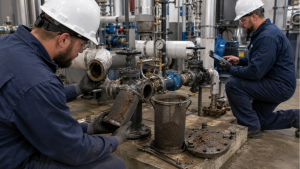
Maintenance technicians inspect debris-loaded strainer screens to determine cleaning needs and identify possible system contamination.
What Does an Industrial Strainer Do?
An industrial strainer removes unwanted solid material from a flowing system before that debris reaches downstream equipment.
Depending on the application, strainers may capture:
- Rust
- Pipe scale
- Sediment
- Welding debris
- Dirt
- Process solids
- Construction debris
- Other foreign material
Strainers can help protect equipment such as:
- Steam traps
- Pumps
- Control valves
- Regulators
- Check valves
- Heat exchangers
- Flowmeters
- Other sensitive pipeline components
Colton offers several strainer configurations because different systems have different debris, flow, and maintenance requirements. Y-strainers are commonly used for steam, condensate, gas, and general liquid service, while basket strainers are often used where larger screen area and greater dirt-holding capacity are needed.
The strainer’s job sounds simple.
The maintenance challenge is knowing when accumulated debris has become enough to affect system performance.
What Are the Signs That a Strainer Needs Cleaning?
These seven indicators should prompt inspection.
1. Differential Pressure Across the Strainer Is Increasing
One of the strongest indicators of strainer loading is an increase in differential pressure, or the pressure difference between the upstream and downstream sides of the strainer.
As debris accumulates on the screen:
- Open flow area decreases
- Resistance increases
- Downstream pressure may fall
- Flow can become restricted
A steadily rising pressure differential can therefore provide a practical indication that the screen or basket is becoming loaded.
What pressure drop means a strainer should be cleaned?
There is no single pressure-drop value that applies to every industrial strainer.
The appropriate limit depends on:
- Strainer design
- Screen construction
- Fluid
- Flow rate
- Operating pressure
- Equipment requirements
- Manufacturer recommendations
For systems where pressure loss is important, establish a clean-screen baseline and monitor how the differential changes during operation.
Some Colton fabricated basket strainers can be supplied with differential-pressure connections specifically for system monitoring.
2. Flow Through the System Has Decreased
A clogged strainer can become a significant flow restriction.
Maintenance teams may notice:
- Reduced process flow
- Lower pump performance
- Slow equipment response
- Reduced condensate drainage
- Lower downstream pressure
- Equipment struggling to maintain capacity
The strainer should be considered whenever flow problems develop unexpectedly.
However, reduced flow does not automatically mean the strainer is clogged.
Other possible causes include:
- Partially closed valves
- Pump problems
- Control-valve issues
- Piping restrictions
- Pressure changes
- Downstream equipment problems
The stronger troubleshooting approach is to compare system performance with pressure conditions before and after the strainer.
3. Downstream Equipment Is Not Performing Normally
A strainer exists primarily to protect downstream equipment, but excessive debris accumulation can eventually restrict the very flow that equipment requires.
Depending on the system, a clogged strainer may contribute to poor performance from:
- Steam traps
- Pumps
- Control valves
- Pressure regulators
- Heat exchangers
- Other flow-dependent equipment
For example, a heavily restricted strainer upstream of a steam trap can reduce the pressure available for condensate discharge.
That can produce symptoms that appear to be a trap failure even when the steam trap itself remains mechanically functional.
This is one reason Colton recommends inspecting strainers alongside steam traps and other components during steam-system maintenance. Its current seasonal maintenance guidance specifically calls for checking differential pressure, cleaning or blowing down Y-strainers as needed, inspecting baskets or screens, and looking for damaged screens.
4. The Screen or Basket Contains Significant Debris
Sometimes the most direct answer comes from inspection.
When a strainer is safely isolated and opened according to the appropriate maintenance procedure, inspect the screen or basket for:
- Rust
- Scale
- Sediment
- Fibrous material
- Process solids
- Weld slag
- Construction debris
- Damaged or deformed screen material
The quantity and type of debris can help determine the future cleaning schedule.
Why should you record what is found in the strainer?
Because the debris itself provides useful system information.
For example:
- Heavy scale may indicate internal pipe corrosion.
- Weld slag or construction material may be associated with commissioning.
- Repeated large debris loads may indicate a problem elsewhere in the system.
- Fine recurring solids may suggest the selected screen needs review.
Maintenance teams should not only clean the screen.
They should ask:
Why is this material reaching the strainer, and is the current strainer configuration appropriate for it?
5. Cleaning Is Becoming More Frequent
If a strainer that previously operated for months between cleanings now plugs every few weeks, investigate the change.
Possible causes include:
- Increased debris in the system
- Corrosion
- Recent piping work
- System startup
- Process changes
- A screen that is too fine for the application
- Increased flow
- Damage elsewhere in the piping
- Incorrect strainer selection
Repeated plugging should not simply become part of the maintenance routine.
It may indicate that the strainer is:
- Undersized
- Using an unnecessarily fine screen
- Handling more debris than expected
- The wrong configuration for the service
Colton’s strainer selection guidance emphasizes matching the strainer style, screen or mesh, and allowable pressure drop to the fluid and expected debris load.
6. Pressure or Flow Problems Appear After Startup or Maintenance Work
New or recently modified piping can contain substantial amounts of temporary debris.
This may include:
- Weld slag
- Scale
- Metal fragments
- Construction material
- Dirt introduced during installation
As a result, strainers may load much faster during commissioning than during normal operation.
Should strainers be checked more often after startup?
Yes. New systems or recently modified piping may require more frequent strainer inspection during initial operation because construction and startup debris can accumulate quickly.
This is also where temporary strainers can play an important role.
Colton’s temporary strainers are designed primarily for new pipeline startup or applications with minimal solid loading and are available in conical, basket, and plate configurations.
Once commissioning debris has been removed, maintenance frequency can usually be adjusted based on normal operating conditions.
7. The Strainer Screen Is Damaged or Collapsed
Cleaning is not always enough.
During inspection, look for:
- Torn mesh
- Cracked screens
- Deformation
- Collapsed baskets
- Damaged perforated plate
- Corrosion
- Loose screen construction
A damaged screen may allow debris to bypass the strainer and reach downstream equipment.
Severe differential pressure across a heavily loaded screen can also place additional mechanical stress on the straining element.
Colton offers replacement strainer screens for its strainer product lines.
If screen damage occurs repeatedly, investigate whether:
- Cleaning intervals are too long
- Differential pressure is becoming excessive
- The screen construction is appropriate
- The selected open area is adequate
- Flow or debris conditions have changed
How Often Should a Y-Strainer Be Cleaned?
A Y-strainer should be cleaned based on actual debris accumulation and flow restriction rather than an arbitrary universal interval.
Some systems may require inspection:
- During startup
- Weekly under heavy contamination
- Monthly
- Quarterly
- During scheduled shutdowns
- Only when differential pressure indicates restriction
The correct schedule depends on the system.
Colton’s current maintenance guidance recommends checking differential pressure where gauges are installed and cleaning or blowing down Y-strainers as needed rather than prescribing one fixed interval.
What affects Y-strainer cleaning frequency?
The main factors include:
- Media
- Debris load
- Screen opening
- Strainer size
- Flow rate
- Pressure
- Operating hours
- System cleanliness
- Startup conditions
A steam system with relatively little debris may require infrequent cleaning.
A newly commissioned line containing scale and construction material may require several inspections within a much shorter period.
How Often Should a Basket Strainer Be Cleaned?
Basket strainers should also be cleaned based on loading and operating performance, not a universal calendar.
Because basket strainers generally provide greater straining area and dirt-holding capacity than Y-strainers, they may operate longer between cleaning cycles in comparable conditions.
However, actual frequency still depends on:
- Debris concentration
- Basket size
- Screen opening
- Flow rate
- Pressure-drop limit
- Process criticality
Colton’s basket strainer range includes standard, quick-opening, duplex, and fabricated configurations designed for different service conditions.
For applications requiring frequent access, maintenance considerations may influence the strainer configuration selected in the first place.
When Should You Use a Duplex Basket Strainer?
A standard simplex basket strainer generally requires the system to be isolated before the basket is removed.
That can be impractical when continuous flow is required.
A duplex basket strainer provides two straining chambers so flow can be switched from one basket to the other.
This allows maintenance personnel to isolate and clean one basket while the other remains in service.
Colton includes duplex basket strainers in its current product portfolio.
When is a duplex strainer useful?
Consider one when:
- Production cannot easily stop
- The process operates continuously
- Debris loading requires frequent cleaning
- Maintaining flow during maintenance is important
This is a good example of why maintainability should be considered during strainer selection, not after installation.
Does Screen Size Affect How Often a Strainer Needs Cleaning?
Yes.
A finer screen captures smaller particles, but it also has smaller openings available for flow.
Depending on the open area and debris characteristics, a finer screen may:
- Load faster
- Require more frequent cleaning
- Create greater pressure loss
- Become restricted by smaller particles
A coarser screen may operate longer but allow larger particles downstream.
The right screen therefore needs to balance:
Equipment protection + acceptable pressure drop + maintenance frequency
Colton’s strainer products are available with various perforations, meshes, and screen materials depending on the specific product and application. Its fabricated basket strainers can also be configured with special screen open-area ratios and differential-pressure connections.
Can a Strainer Be Too Fine?
Yes.
Using the finest possible screen is not automatically the best way to protect equipment.
An unnecessarily fine screen may:
- Restrict flow
- Increase pressure drop
- Plug frequently
- Increase maintenance
- Create operating problems
The screen should be fine enough to protect the downstream component without creating unnecessary restriction.
Colton’s strainer selection guidance recommends matching the screen or mesh to both the debris and the needs of the equipment downstream.
What Should You Inspect When Cleaning a Strainer?
Cleaning is also an opportunity to evaluate the strainer’s condition.
Inspect the Screen or Basket
Check for:
- Tears
- Holes
- Cracks
- Deformation
- Corrosion
- Collapsed sections
Inspect the Debris
Document:
- Type
- Approximate quantity
- Particle size
- Anything unusual
Inspect the Body
Look for:
- Corrosion
- Erosion
- Deposits
- Damage
Inspect the Cover and Gasket
Check sealing surfaces and replace damaged gasket materials according to the product’s maintenance requirements.
Review Cleaning Frequency
Ask whether the current interval is:
- Too frequent
- Too long
- Appropriate for the application
Compare With Previous Inspections
Trend information is more useful than a single inspection.
Repeated debris patterns may reveal broader system conditions.
How Do You Know If a Strainer Is Clogged?
A clogged industrial strainer may produce one or more of these symptoms:
- Increased differential pressure
- Reduced downstream pressure
- Lower flow
- Poor downstream equipment performance
- Frequent pump or process issues
- Reduced condensate drainage
- Visible heavy debris loading during inspection
The strongest evidence often comes from combining:
System performance + pressure readings + physical inspection
Do not assume the screen is clogged based on one symptom alone.
Can a Clogged Strainer Cause Pressure Drop?
Yes. As debris accumulates on a strainer screen, resistance to flow generally increases, creating additional pressure drop across the strainer.
If restriction becomes severe, downstream equipment may not receive the flow or pressure it needs.
Colton specifically identifies pressure drop as a core consideration when selecting and sizing a pipeline strainer.
This is why pressure differential can be such a valuable maintenance indicator.
Can a Clogged Strainer Affect a Steam Trap?
Yes. A severely restricted strainer upstream of a steam trap can reduce available flow and pressure, potentially interfering with condensate drainage.
That may create symptoms such as:
- Poor condensate removal
- Equipment flooding
- Slow heating
- Abnormal trap behavior
This does not mean the strainer is always the cause of trap problems.
Maintenance teams should evaluate:
- The steam trap
- Upstream strainer
- Differential pressure
- Condensate-return conditions
- Isolation valves
- Piping configuration
Colton’s seasonal steam-system guidance recommends inspecting these components together rather than troubleshooting them in isolation.
How Do You Establish a Strainer Cleaning Schedule?
Instead of choosing an arbitrary interval, use a simple four-step approach.
Step 1: Establish a Clean Baseline
After installing or cleaning the strainer, record:
- Upstream pressure
- Downstream pressure
- Flow rate where available
- Process performance
This gives maintenance teams a reference point.
Step 2: Monitor Performance
Track changes in:
- Differential pressure
- Flow
- Downstream equipment performance
Step 3: Inspect and Document Debris
At each cleaning, record:
- Amount of debris
- Type of debris
- Screen condition
- Time since previous cleaning
Step 4: Adjust the Interval
If the screen remains mostly clean, the interval may be extended where appropriate.
If the strainer becomes heavily loaded before the scheduled cleaning, shorten the interval or investigate whether another strainer configuration is more suitable.
The objective is a condition-based maintenance schedule informed by actual operating history.
When Is Frequent Cleaning a Sign That You Need a Different Strainer?
If cleaning becomes excessive, reconsider the selection.
Ask:
- Is the screen too fine?
- Is the strainer undersized?
- Is debris loading higher than originally expected?
- Would a larger basket provide greater dirt capacity?
- Would a duplex basket strainer reduce downtime?
- Is a temporary strainer still installed after startup?
- Has the process changed?
- Is excessive corrosion creating debris?
Colton’s own strainer selection guidance notes that a poorly selected strainer can plug constantly and create unnecessary maintenance. Selecting the correct design requires considering fluid, debris load, screen or mesh, pressure drop, and cleaning access.
This supports an important maintenance principle:
If a component repeatedly creates the same problem, do not simply maintain it more often. Determine whether the component is still right for the application.
Frequently Asked Questions About Industrial Strainer Cleaning
How do you know when an industrial strainer needs cleaning?
An industrial strainer typically needs cleaning when pressure drop increases, flow decreases, downstream equipment begins underperforming, or physical inspection shows significant debris accumulation.
How often should a Y-strainer be cleaned?
There is no universal interval. A Y-strainer should be cleaned based on debris loading, differential pressure, flow restriction, system conditions, and operating history. Colton recommends cleaning or blowing down Y-strainers as needed.
How often should a basket strainer be cleaned?
Basket strainers should be cleaned when debris accumulation begins to create unacceptable restriction or pressure drop. Their larger dirt-holding capacity can often allow longer maintenance intervals than comparable Y-strainers, but actual frequency depends on the application.
How do you know if a strainer is clogged?
Common indicators include increasing differential pressure, reduced downstream flow or pressure, declining equipment performance, and heavy debris buildup on the screen.
Can a clogged strainer cause pressure drop?
Yes. Debris reduces available open flow area and increases resistance, causing pressure drop across the strainer.
Can a clogged strainer affect a steam trap?
Yes. Severe upstream restriction can reduce the pressure and flow available for effective condensate drainage, although other system conditions should also be investigated.
Should strainers be cleaned more frequently after startup?
Yes. Recently installed or modified piping may release construction debris, scale, and weld material, so inspection frequency may need to increase temporarily during commissioning. Colton’s temporary strainers are specifically intended for pipeline startup and similar conditions.
Clean Based on Condition, Not Just the Calendar
So, how do you know when an industrial strainer needs cleaning?
Look for:
- Increasing differential pressure
- Reduced flow
- Poor downstream equipment performance
- Significant debris accumulation
- Increasing cleaning frequency
- Startup-related restriction
- Screen or basket damage
There is no universal rule that every industrial strainer should be cleaned every month, quarter, or year.
The stronger approach is to understand how quickly the strainer loads under the actual operating conditions.
At Colton Industries, strainer selection starts with the application: line size, media, operating pressure and temperature, debris load, screen requirements, allowable pressure drop, and maintenance access.
Colton offers Y-strainers, basket strainers, duplex strainers, replacement screens, and temporary strainers for industrial and commercial piping systems.
Final Takeaway
An industrial strainer should be cleaned before debris accumulation creates unacceptable flow restriction or pressure drop.
Rather than relying only on a fixed maintenance interval:
- Establish a clean baseline
- Monitor pressure differential
- Watch for flow changes
- Inspect downstream performance
- Document debris at each cleaning
- Adjust maintenance frequency based on actual conditions
And when a strainer repeatedly plugs, investigate the root cause.
The problem may not be the cleaning schedule.
It may be the screen selection, strainer size, strainer type, debris load, or the application itself.
Explore Colton’s industrial strainer solutions or contact Colton Industries to discuss strainer selection, replacement screens, or maintenance requirements for your system.
