
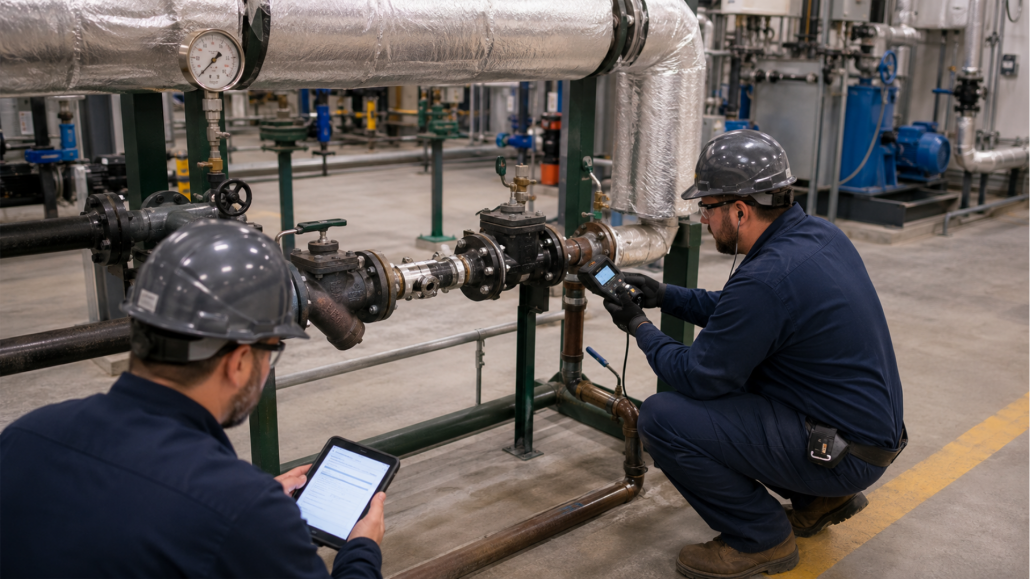
What Should You Check Before Starting a Steam System for Heating Season?
What Should Be Inspected Before Heating Season?
Before starting a steam system for heating season, facility teams should inspect steam traps, strainers, valves, condensate return lines, drainage points, pressure-reducing equipment, insulation, and startup procedures.
The goal is to confirm that condensate can drain properly, valves and traps are operating as intended, strainers are clear, and the system can warm up gradually without creating unnecessary stress or water hammer.
For facilities that reduced steam demand during warmer months, late summer or early fall is a practical time to identify problems before heating loads increase.
At Colton Industries, reliable startup begins with looking at the steam system as a whole. Steam traps, strainers, valves, check valves, and condensate piping all need to work together for the system to perform reliably. Colton supplies a broad range of steam and pipeline flow-control products for industrial and commercial applications.
Why Is a Pre-Heating-Season Steam System Inspection Important?
Steam systems can experience very different operating conditions during summer and winter.
Some facilities reduce steam loads during warmer months. Others shut down portions of their systems for maintenance, operate at lower pressures, or run process steam without full building-heating demand.
When heating season begins, the system may suddenly experience:
- Longer operating periods
- Higher condensate loads
- More frequent cycling
- Increased steam demand
- Cold piping during initial startup
- Components returning to service after months of limited operation
Problems that were easy to overlook during summer can become much more noticeable once demand increases.
A pre-season inspection allows maintenance teams to correct issues before they develop into:
- Poor heating
- Condensate backup
- Steam loss
- Water hammer
- Restricted flow
- Valve problems
- Emergency maintenance during cold weather
Colton already recommends reviewing traps, strainers, valves, and condensate-return conditions during seasonal system inspections because these components work together rather than independently.
Maintenance technicians inspect steam traps, valves, strainers, and condensate components before seasonal steam demand increases.
What Should You Check Before Starting a Steam System?
A practical pre-startup inspection should cover at least the following eight areas.
1. Test Steam Traps Before Demand Increases
Steam traps should be one of the first components reviewed.
Their job is to remove condensate and non-condensable gases while preventing useful live steam from escaping.
If a trap has failed open, it may waste live steam.
If it has failed closed, become blocked, or cannot discharge condensate properly, condensate can accumulate upstream.
Before heating season, look for traps that:
- Continuously pass live steam
- Do not discharge when condensate should be present
- Show unusual temperature patterns
- Leak externally
- Operate abnormally
- Have a history of repeated failure
A steam trap survey can help identify failed, blocked, leaking, or misapplied traps before the system is operating under heavier seasonal load.
Colton’s guidance on mid-year steam trap surveys recommends evaluating not just whether traps work, but also associated strainers, valves, piping, and operating conditions.
Should steam traps be tested before winter?
Yes. For seasonal heating systems, testing steam traps before winter is a practical preventive-maintenance step because failed traps can contribute to steam loss, poor drainage, reduced heating performance, and water hammer.
Facilities should also consider the trap’s pressure, application, operating history, and criticality when determining inspection frequency.
Explore Colton’s industrial steam trap options for different steam and condensate applications.
2. Inspect and Clean Strainers
A steam trap, control valve, regulator, or other downstream component can only perform properly if flow is not being restricted upstream.
Strainers help capture:
- Rust
- Scale
- Sediment
- Installation debris
- Other solids
Over time, those materials accumulate on the screen.
A heavily loaded strainer can create additional pressure drop and restrict steam, condensate, or other media.
Before startup:
- Inspect screens or baskets
- Clean accumulated debris
- Check for damaged or collapsed screens
- Verify blowdown connections where applicable
- Look for unusual pressure differential
- Confirm proper installation orientation
For Y-strainers in steam service, orientation matters because the screen pocket should not create an unnecessary condensate collection point.
Colton Industries offers Y-strainers, basket strainers, duplex strainers, temporary strainers, and replacement screens across a variety of industrial applications.
Can a clogged strainer affect heating performance?
Yes. A clogged strainer can restrict flow and increase pressure drop, which can affect downstream steam traps, valves, heat-transfer equipment, and other components.
A strainer should therefore be treated as part of the operating system, not simply as a passive fitting.
3. Check Valves for Leakage and Proper Operation
Valves that have remained in one position for an extended period should be inspected before seasonal operation changes.
Check for:
- External leakage
- Packing leakage
- Difficulty opening or closing
- Incomplete shutoff
- Corrosion
- Damaged operators
- Loose connections
- Abnormal noise or vibration
Isolation valves should be capable of fully opening when required.
Partially closed valves can restrict flow and complicate troubleshooting because they may create symptoms similar to other steam-system problems.
Control and pressure-reducing valves also deserve attention because changes in pressure can affect downstream trap performance, heating capacity, and condensate drainage.
Colton’s product portfolio includes a range of industrial valves and pipeline flow-control products, including pressure-reducing valves, check valves, quarter-turn valves, and triple-duty valves.
4. Inspect Check Valves and Condensate Return Components
Check valves help control flow direction and prevent unwanted reverse flow.
Before heating season, inspect check valves for signs such as:
- Leakage
- Chattering
- Abnormal noise
- Reverse-flow symptoms
- Corrosion
- Restricted movement
Check valves in condensate-return systems can be especially important where condensate must move against varying downstream pressures.
The condensate system itself should also be checked for:
- Leaks
- Corroded piping
- Restricted lines
- Improperly closed valves
- Unusual backpressure
- Low points where condensate can collect
A steam trap cannot discharge effectively if downstream conditions prevent condensate from leaving the trap.
That means poor trap performance may sometimes be caused by the return system rather than the trap mechanism itself.
5. Check Steam Mains, Drip Legs, and Low-Point Drainage
Cold steam piping generates a significant amount of condensate during startup.
As steam enters a cold line, heat transfers into the pipe wall and surrounding environment. Steam condenses until the piping warms toward operating temperature.
That startup condensate needs somewhere to go.
Maintenance teams should inspect:
- Steam-main drip legs
- Low-point drains
- Trap stations
- Branch connections
- Separators where installed
- Drainage around equipment
- Piping slope
Why is condensate drainage important during startup?
Poor condensate drainage can allow water to collect in steam piping. When high-velocity steam interacts with accumulated condensate, severe water hammer can occur.
Water hammer can damage piping, valves, supports, and other equipment. Proper steam-main drainage and startup practices are therefore essential parts of heating-season preparation.
TLV identifies condensate accumulation and the interaction of steam with accumulated water as key mechanisms behind steam-system water hammer.
If a line experienced water hammer during the previous heating season, investigate the root cause before placing it back into full operation.
Do not assume the problem will disappear on its own.
6. Review Pressure Conditions and Pressure-Reducing Equipment
Pressure conditions may change as seasonal demand increases.
Before startup, verify that:
- Pressure gauges are functional
- Pressure-reducing valves operate properly
- Setpoints remain appropriate
- Downstream pressure is stable
- Trap differential pressure is adequate
- Condensate backpressure remains within acceptable conditions
Steam traps rely on pressure differential to discharge condensate.
A trap can be mechanically functional but still struggle to drain if the pressure downstream approaches or exceeds the pressure available at the trap inlet.
For process equipment where control valves regulate steam supply, this becomes particularly important under low-load conditions.
The correct steam trap should be selected based on actual application requirements, including operating pressure, differential pressure, condensate load, and startup conditions. Colton’s existing steam trap selection guidance emphasizes this application-first approach.
7. Inspect Insulation and Exposed Piping
Damaged or missing insulation increases heat loss.
Before heating season, inspect insulation around:
- Steam mains
- Distribution lines
- Valves
- Fittings
- Separators
- Condensate piping where appropriate
Look for:
- Missing sections
- Wet insulation
- Damaged jacketing
- Areas removed during maintenance but never replaced
- Signs of corrosion beneath damaged insulation
Insulation problems can increase energy loss and create unnecessarily hot mechanical spaces.
However, do not insulate components that manufacturers specify should remain exposed for proper operation or inspection.
Always follow applicable equipment and facility requirements.
8. Review the Startup Procedure Before Opening Steam
Even a well-maintained steam system can experience problems if startup is rushed.
When steam is introduced into cold piping too quickly, condensate production can be substantial.
A controlled startup typically allows:
- Piping to warm gradually
- Condensate to drain
- Air to leave the system
- Pressure to increase in a controlled manner
- Operators to identify abnormal conditions early
During startup, listen and watch for:
- Water hammer
- Excessive vibration
- Valve leakage
- Trap stations that remain cold
- Traps continuously blowing steam
- Poor heating
- Abnormal pressure behavior
Should steam valves be opened slowly during startup?
In many steam systems, gradual warm-up is important because introducing steam too quickly into cold piping can produce large amounts of condensate and increase the risk of water hammer.
Startup procedures should follow the facility’s operating requirements and equipment-manufacturer guidance.
What Should Be Included in a Pre-Heating-Season Steam Checklist?
Use this practical checklist before seasonal demand increases.
Steam Traps
- Test trap operation
- Check for failed-open traps
- Check for blocked or failed-closed traps
- Inspect external leakage
- Review repeat failures
- Confirm trap selection still matches the application
Strainers
- Remove accumulated debris
- Inspect screens or baskets
- Replace damaged screens
- Check pressure drop where measurable
- Verify proper orientation
Valves
- Check operation
- Inspect leakage
- Confirm full opening and closing
- Review pressure-reducing equipment
Condensate System
- Inspect return piping
- Check check valves
- Look for leaks
- Review backpressure
- Verify drainage from low points
Steam Distribution
- Inspect drip legs
- Verify piping drainage
- Check known water-hammer locations
- Review pipe supports
- Inspect insulation
Startup
- Confirm operating procedures
- Warm the system gradually
- Monitor pressure
- Listen for unusual noise
- Watch for condensate drainage problems
What Are the Most Common Problems Found Before Heating Season?
Pre-season inspections often uncover problems such as:
Failed Steam Traps
A failed-open trap may waste steam, while a blocked trap may contribute to condensate backup.
Clogged Strainers
Debris accumulated during previous operation can restrict flow.
Leaking Valves
Valve leakage can worsen with cycling and thermal expansion.
Poor Condensate Drainage
Blocked traps, poor piping slope, high return pressure, or improperly operating check valves can prevent effective drainage.
Water Hammer History
Noise from the prior season may indicate unresolved drainage or piping problems.
Damaged Insulation
Missing insulation can increase heat loss once the system returns to full seasonal operation.
Temporary Repairs
Maintenance teams should review any temporary fixes made during the previous winter and determine whether permanent repairs are needed.
This is also a good time to ask operators:
- Which areas heated poorly last winter?
- Where did water hammer occur?
- Which traps failed?
- Which strainers clogged repeatedly?
- Which valves leaked?
- What required emergency attention?
Field experience from the previous heating season can reveal problems that a visual inspection alone may miss.
Should You Replace Steam Traps Before Heating Season?
Not every older steam trap needs to be replaced simply because heating season is approaching.
Replacement should be based on:
- Confirmed failure
- Physical deterioration
- Repeated repair history
- Incorrect application
- Changed operating conditions
- Lack of repair parts
- Poor reliability
If a trap repeatedly fails, consider whether the existing model is still appropriate for the application.
Colton’s guide on when to replace a steam trap explains that repeated maintenance, water hammer, poor heating, corrosion, and traps that no longer match the application can all justify closer evaluation.
The goal should not be to replace components unnecessarily.
It should be to enter heating season with components that are correctly selected and operating reliably.
Frequently Asked Questions About Steam System Heating-Season Preparation
What should you inspect before starting a steam system?
Inspect steam traps, strainers, valves, check valves, condensate-return piping, drip legs, pressure-reducing equipment, insulation, and drainage points. Confirm that components operate correctly and that condensate can leave the system before increasing steam demand.
Should steam traps be tested before winter?
Yes. Testing steam traps before heating season helps identify steam leakage, blocked traps, poor condensate drainage, and repeat failures before seasonal demand increases.
Why do steam systems experience water hammer during startup?
Water hammer can occur when condensate collects inside cold steam piping and is moved rapidly by incoming steam. Proper drainage, controlled warm-up, functioning steam traps, and appropriate piping design help reduce the risk.
Should strainers be cleaned before heating season?
Strainers should be inspected before startup and cleaned when debris accumulation is sufficient to restrict flow. Cleaning frequency should be based on actual system dirt load and operating history rather than a fixed universal schedule. Colton recommends adjusting strainer maintenance based on real debris accumulation.
What causes poor condensate drainage during startup?
Possible causes include failed or undersized steam traps, clogged strainers, insufficient differential pressure, high condensate-return pressure, closed valves, poor piping slope, or drainage-design problems.
How can facilities prepare steam systems for winter?
A strong winter-preparation program combines inspection, steam-trap testing, strainer maintenance, valve checks, condensate-drainage review, insulation inspection, and controlled startup procedures.
Think Beyond Individual Components
One of the most important lessons in steam-system maintenance is that individual components do not operate independently.
A steam trap may appear faulty when the real issue is:
- A clogged strainer upstream
- Excessive backpressure downstream
- An incorrectly positioned valve
- Poor drainage
- The wrong trap for the application
Likewise, replacing a valve will not resolve water hammer caused by condensate accumulation elsewhere in the line.
The stronger approach is to evaluate the entire steam and condensate path.
Colton Industries began with Y- and basket-type strainers and has grown into a second-generation, family-owned North American supplier of steam traps, valves, check valves, flexible connectors, pipeline specialties, and related flow-control equipment.
Final Takeaway
So, what should you check before starting a steam system for heating season?
Start with the components and conditions that most directly affect steam distribution and condensate removal:
- Test steam traps
- Inspect and clean strainers
- Check valves
- Review check valves and condensate-return piping
- Verify drip legs and drainage
- Confirm pressure conditions
- Inspect insulation
- Review startup procedures
Most importantly, investigate known trouble spots from the previous heating season before demand increases again.
A pre-season inspection gives maintenance teams an opportunity to move from reactive winter repairs to planned preventive maintenance.
Explore Colton Industries’ steam and pipeline products or contact Colton Industries to discuss steam traps, strainers, valves, check valves, and related components for your application.
